
Have you ever looked at a floor tile, a chessboard, or a window and wondered how much space it covers? The answer lies in one of the simplest yet most useful concepts in geometry—the square area formula.
Although it looks easy at first glance, understanding how the formula works can make solving geometry problems much faster and more accurate. Whether you’re a student preparing for exams, a teacher explaining basic mathematics, or simply someone who enjoys learning practical math concepts, mastering the area of a square is an essential skill.
The best part is that you only need to know one measurement—the length of a side. From there, calculating the area becomes straightforward. In this guide, we’ll cover everything from the definition of a square to step-by-step calculations, solved examples, common mistakes, practical applications, and frequently asked questions. By the end, you’ll understand not only how to use the square area formula but also why it plays such an important role in mathematics and real life.
What Is a Square?
A square is a two-dimensional geometric shape with four equal sides and four right angles. Every angle measures exactly 90 degrees, making it one of the most symmetrical shapes in geometry.
Some important properties of a square include:
- Four equal sides
- Four right angles
- Opposite sides are parallel
- Diagonals are equal in length
- Diagonals bisect each other at right angles
- Four lines of symmetry
- Rotational symmetry of order four
These unique properties make squares one of the easiest shapes to analyze when learning geometry.
What Is Area?
Before learning the square area formula, it’s important to understand what area actually means.
Area refers to the amount of surface enclosed within a two-dimensional figure. It tells us how much space a shape occupies.
Area is measured in square units such as:
- Square centimeters (cm²)
- Square meters (m²)
- Square inches (in²)
- Square feet (ft²)
- Square kilometers (km²)
Unlike perimeter, which measures the distance around a shape, area measures the space inside it.
The Square Area Formula
The square area formula is one of the most basic formulas in geometry.
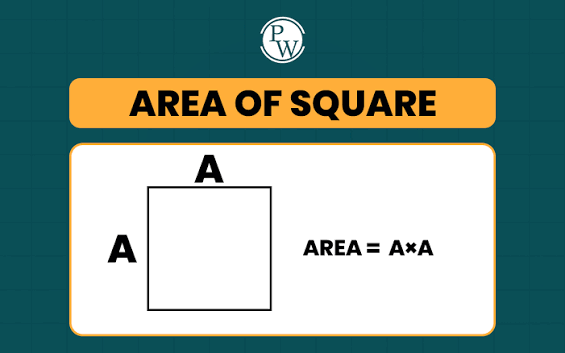
Area of Square = Side × Side
Or simply,
Area = s²
where:
- Area = total space inside the square
- s = length of one side
Since every side of a square has the same length, multiplying one side by itself gives the total area.
This square area formula works for every square, regardless of its size.
Why Does the Square Area Formula Work?
Imagine drawing a square with each side measuring 5 units.
If you divide it into tiny 1 × 1 unit squares, you’ll notice:
- 5 rows
- 5 columns
Total squares:
5 × 5 = 25
That’s exactly why the square area formula is written as:
Area = side × side
The formula simply counts how many unit squares fit inside the larger square.
Step-by-Step Guide to Using the Square Area Formula
Calculating the area is incredibly easy if you follow these simple steps.
Step 1: Measure One Side
Find the length of any side.
Example:
Side = 8 cm
Step 2: Square the Length
Multiply the side by itself.
8 × 8 = 64
Step 3: Write the Correct Unit
Area = 64 cm²
That’s it!
The square area formula only requires one measurement.
Solved Examples
Let’s look at several examples of the square area formula in action.
Example 1
Side = 4 cm
Area = 4²
Area = 16 cm²
Example 2
Side = 9 m
Area = 9²
Area = 81 m²
Example 3
Side = 12 inches
Area = 12 × 12
Area = 144 in²
Example 4
Side = 15 feet
Area = 15²
Area = 225 ft²
Example 5
Side = 20 mm
Area = 20 × 20
Area = 400 mm²
These examples show how quickly the square area formula can be applied once the side length is known.
Formula Using the Diagonal
Sometimes the side length isn’t given. Instead, you’re provided with the diagonal.
In that case, another version of the square area formula is used.
Area = d² ÷ 2
where:
- d = diagonal
Example
Diagonal = 10 cm
Area = 10² ÷ 2
Area = 100 ÷ 2
Area = 50 cm²
This method is especially useful in geometry questions involving diagonals.
Square Area Formula Table
| Side Length | Area |
|---|---|
| 1 | 1 |
| 2 | 4 |
| 3 | 9 |
| 4 | 16 |
| 5 | 25 |
| 6 | 36 |
| 7 | 49 |
| 8 | 64 |
| 9 | 81 |
| 10 | 100 |
This quick reference table helps students calculate areas without repeatedly multiplying.
Real-Life Applications
The square area formula isn’t limited to classrooms. It’s used almost everywhere.
Home Construction
Builders calculate flooring materials using area.
Interior Design
Carpet installation depends on room measurements.
Gardening
Square garden beds require area calculations before planting.
Painting
Wall surfaces are measured to estimate paint quantity.
Architecture
Architects rely on area calculations while designing rooms.
Land Measurement
Surveyors use area formulas for property planning.
Manufacturing
Factories determine sheet sizes and material usage.
Tile Installation
Tile contractors calculate total floor area before purchasing materials.
Difference Between Area and Perimeter
Many students confuse these two concepts.
| Area | Perimeter |
| Measures inside space | Measures boundary |
| Square units | Linear units |
| Formula = side² | Formula = 4 × side |
Knowing this difference helps avoid mistakes during exams.
Common Mistakes Students Make
Learning the square area formula is simple, but errors still happen.
Forgetting to Square the Side
Incorrect:
Area = 7
Correct:
Area = 49
Using the Perimeter Formula
Some students mistakenly calculate:
4 × side
instead of
side × side
Forgetting Units
Always write:
cm²
m²
ft²
Never just write the number.
Mixing Units
Don’t multiply centimeters by meters.
Convert units first before using the formula.
Tips to Remember the Square Area Formula
Here are a few easy memory tricks:
- A square has equal sides.
- Area always means inside space.
- Multiply one side by itself.
- Area units are always squared.
- If given the diagonal, use the diagonal formula.
These shortcuts make solving problems much easier.
Practice Questions
Try solving these on your own.
- Side = 11 cm
- Side = 14 m
- Side = 25 inches
- Side = 30 feet
- Diagonal = 8 cm
Answers:
- 121 cm²
- 196 m²
- 625 in²
- 900 ft²
- 32 cm²
Practice is the fastest way to master the square area formula.
Advantages of Learning the Square Area Formula
Understanding this formula provides many benefits.
- Builds a strong geometry foundation
- Improves mathematical reasoning
- Useful in higher mathematics
- Helps solve competitive exam questions
- Supports engineering calculations
- Useful in architecture and design
- Makes everyday measurements easier
- Develops logical thinking skills
Interesting Facts About Squares
Squares are fascinating shapes with unique characteristics.
- Every square is also a rectangle.
- Every square is also a rhombus.
- The diagonals are always equal.
- A square has the maximum area among quadrilaterals with the same perimeter.
- Chessboards are made of squares.
- Pixels on many digital screens are arranged in square grids.
These facts show why squares appear so often in mathematics and design.
They measure different things and cannot be directly compared because they have different units.
Why is the formula important?
It helps calculate surfaces accurately in mathematics, engineering, construction, architecture, and everyday measurements.
Key Takeaways
Here’s a quick summary:
- A square has four equal sides.
- Area measures the space inside the square.
- The square area formula is Area = s².
- If the diagonal is known, use Area = d² ÷ 2.
- Always use square units.
- Practice regularly to improve speed and accuracy.
Understanding these basics makes geometry much easier.
Conclusion
The square area formula is one of the first geometry concepts every learner should master because it combines simplicity with practical value. From solving school assignments to planning home renovations, calculating land measurements, designing buildings, or estimating flooring materials, this formula has countless real-world applications.
Once you remember that the area equals the side multiplied by itself, solving questions becomes quick and effortless. As you continue practicing different examples, you’ll develop greater confidence in geometry and strengthen your overall mathematical skills. Don’t just memorize the formula—understand why it works, apply it in everyday situations, and challenge yourself with new problems to deepen your learning.