
Have you ever completed a science experiment, solved a math problem, or measured something in real life only to discover that your answer wasn’t exactly the same as the expected value? Don’t worry—you aren’t alone. Small differences happen all the time, and that’s exactly why the percent error formula exists.
Whether you’re a student preparing for exams, a teacher explaining laboratory results, or someone working with measurements in engineering or manufacturing, understanding how to calculate percent error is an essential skill. It tells you how close your measured value is to the accepted or true value, making it easier to judge the accuracy of your work.
The good news is that the calculation isn’t difficult. Once you understand the formula and the reasoning behind it, solving percent error questions becomes straightforward. In this guide, you’ll learn the percent error formula, how it works, when to use it, common mistakes to avoid, and several real-world examples that make the concept easy to remember.
What Is Percent Error?
Percent error is a mathematical expression that measures how much an experimental value differs from an accepted or true value. Rather than simply looking at the difference, it expresses that difference as a percentage.
Because percentages are easy to compare, percent error helps scientists, researchers, students, and professionals evaluate the accuracy of measurements.
For example, if a laboratory measures the boiling point of water as 99°C instead of the accepted value of 100°C, the result isn’t simply “1 degree off.” The percent error formula tells us exactly how significant that difference is.
In simple words:
- Smaller percent error means greater accuracy.
- Larger percent error means the measurement is farther from the accepted value.
- Zero percent error means the measurement is perfectly accurate.
Why Is the Percent Error Formula Important?
The percent error formula is used in many fields because it provides a standardized way to compare results.
It plays an important role in:
- Science laboratory experiments
- Chemistry calculations
- Physics measurements
- Engineering projects
- Manufacturing quality control
- Medical research
- Data analysis
- Survey measurements
- Statistical studies
- Educational assignments
Instead of guessing whether a measurement is “close enough,” percent error provides a clear numerical answer.
Percent Error Formula
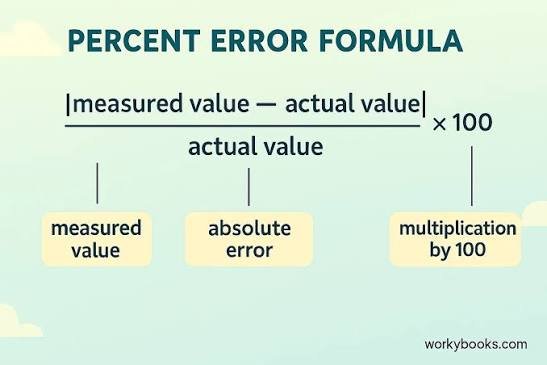
The standard percent error formula is:
The absolute value ensures that the answer is always positive because we’re interested in the size of the error, not whether the measurement is above or below the accepted value.
Understanding Each Part of the Formula
Let’s break it down into simple terms.
| Formula Component | Meaning |
|---|---|
| Experimental Value | The value you measured during the experiment |
| Accepted Value | The known or true value |
| Difference | Experimental value minus accepted value |
| Absolute Value | Removes negative signs |
| Multiply by 100 | Converts the decimal into a percentage |
Understanding each component makes the percent error formula much easier to apply.
Step-by-Step Guide to Calculate Percent Error
Let’s go through the calculation process one step at a time.
Step 1: Write Down Both Values
Identify:
- Experimental value
- Accepted value
Example:
Experimental Value = 48 cm
Accepted Value = 50 cm
Step 2: Find the Difference
Subtract:
48 − 50 = -2
Step 3: Take the Absolute Value
Absolute Value = 2
This removes the negative sign.
Step 4: Divide by the Accepted Value
2 ÷ 50 = 0.04
Step 5: Multiply by 100
0.04 × 100 = 4%
The percent error is 4%.
Following these simple steps makes the percent error formula easy to remember and apply.
Example 1: Science Experiment
A student measures the mass of a metal block.
- Accepted mass = 250 g
- Measured mass = 245 g
Solution
Difference:
245 − 250 = -5
Absolute difference:
5
Divide:
5 ÷ 250 = 0.02
Multiply:
0.02 × 100 = 2%
Percent Error = 2%
Example 2: Temperature Measurement
Accepted temperature = 80°C
Measured temperature = 78°C
Difference:
2
Divide:
2 ÷ 80 = 0.025
Multiply:
0.025 × 100 = 2.5%
Percent Error = 2.5%
Example 3: Length Measurement
Accepted length = 120 cm
Measured length = 117 cm
Difference:
3
Divide:
3 ÷ 120 = 0.025
Multiply:
2.5%
Final Answer:
2.5%
These examples show how the percent error formula works across different types of measurements.
Percent Error vs Absolute Error
Students often confuse these two concepts.
| Percent Error | Absolute Error |
| Expressed as a percentage | Expressed in measurement units |
| Compares with accepted value | Shows only numerical difference |
| Easier for comparing results | Useful for raw measurement differences |
| Includes multiplication by 100 | No percentage conversion |
Both are valuable, but the percent error formula gives more meaningful comparisons.
Percent Error vs Relative Error
Although related, these terms are not identical.
| Relative Error | Percent Error |
| Decimal form | Percentage form |
| Not multiplied by 100 | Multiplied by 100 |
| Used in advanced mathematics | Common in school and laboratory work |
Percent error is simply relative error expressed as a percentage.
Common Mistakes to Avoid
Many students lose marks because of simple errors.
Forgetting Absolute Value
Negative answers are generally incorrect because percent error represents magnitude.
Using the Wrong Denominator
Always divide by the accepted value, not the experimental value.
Forgetting to Multiply by 100
Without multiplying by 100, you’ll end up with relative error instead of percent error.
Mixing Units
Both values must have identical units before applying the percent error formula.
Rounding Too Early
Keep extra decimal places during calculations and round only the final answer.
Practical Applications of Percent Error
The percent error formula isn’t limited to classrooms.
Laboratory Research
Scientists compare experimental results with accepted scientific values.
Engineering
Engineers verify measurement accuracy during construction and manufacturing.
Medicine
Medical laboratories use error calculations to validate diagnostic equipment.
Physics
Physics experiments depend heavily on precise measurements.
Chemistry
Chemical reactions often require highly accurate measurements.
Manufacturing
Factories monitor product dimensions using percent error calculations.
Quality Assurance
Companies use measurement accuracy to maintain consistent product quality.
Environmental Science
Researchers compare collected data with standard reference values.
Tips for Improving Accuracy
Reducing percent error is often the goal of any experiment.
Here are several helpful strategies:
- Calibrate instruments regularly.
- Read measurement scales carefully.
- Repeat experiments several times.
- Use high-quality equipment.
- Minimize human error.
- Record data immediately.
- Double-check calculations.
- Maintain consistent experimental conditions.
Following these practices can significantly reduce your percent error.
Real-Life Example
Imagine buying a digital kitchen scale.
The package says it should measure exactly 100 grams.
You place a standard 100-gram calibration weight on it.
The scale displays:
98 grams
Difference:
2 grams
Using the percent error formula:
2 ÷ 100 × 100
Percent Error = 2%
Now you know the scale is reasonably accurate but not perfect.
Practice Problems
Try solving these yourself.
Problem 1
Accepted value = 200
Experimental value = 194
Answer:
3%
Problem 2
Accepted value = 75
Experimental value = 78
Answer:
4%
Problem 3
Accepted value = 500
Experimental value = 510
Answer:
2%
Practicing regularly helps you master the percent error formula quickly.
Quick Summary
Here’s a simple checklist for using the percent error formula correctly:
- Identify the accepted value.
- Record the experimental value.
- Find the difference.
- Take the absolute value.
- Divide by the accepted value.
- Multiply by 100.
- Add the percentage symbol.
Following these steps ensures consistent and accurate calculations every time.
Final Thoughts
The percent error formula is one of the most practical mathematical tools you’ll encounter in science, mathematics, engineering, and everyday measurements. Rather than simply telling you that a result is different, it explains how much that difference matters by expressing it as a percentage.
As you’ve seen throughout this guide, calculating percent error is a simple process when broken into clear steps. Start by finding the difference between the experimental and accepted values, use the absolute value, divide by the accepted value, and multiply by 100. With enough practice, this calculation becomes second nature.
More importantly, understanding the percent error formula helps you evaluate accuracy, improve experimental techniques, identify mistakes, and make more reliable decisions based on data. Whether you’re solving homework problems, conducting laboratory experiments, working in quality control, or analyzing research findings, this formula remains an essential part of accurate measurement.