
If you’ve recently followed election news, voter registration updates, or discussions about electoral reforms, you may have come across the term SIR. Many people hear this abbreviation but are unsure what it actually means and why it matters in the electoral process.
Understanding the sir full form in election is important because it directly relates to voter records, electoral rolls, and the overall transparency of democratic elections. Whether you are a first-time voter, a political enthusiast, a student, or simply someone interested in how elections work, knowing about SIR can help you better understand the process behind maintaining accurate voter databases.
In this comprehensive guide, we’ll explore the sir full form in election, its purpose, significance, process, benefits, challenges, and frequently asked questions. By the end, you’ll have a complete understanding of why SIR plays such a crucial role in modern electoral systems.
What Is the SIR Full Form in Election?
The sir full form in election is Special Intensive Revision.
Special Intensive Revision is a detailed process conducted by election authorities to verify, update, and correct electoral rolls. The primary objective is to ensure that voter lists remain accurate, current, and free from errors.
Electoral rolls form the backbone of any democratic election. If these lists contain incorrect information, duplicate entries, deceased voters, or missing eligible voters, the integrity of the election can be affected. This is where the Special Intensive Revision process becomes essential.
In simple terms, SIR is a large-scale voter verification exercise carried out to improve the quality and accuracy of voter records.
Why Is SIR Important in Elections?
The sir full form in election may sound like a technical term, but its purpose is straightforward. Elections depend on accurate voter information.
Here are some reasons why SIR is important:
- Ensures eligible citizens are included in voter lists
- Removes duplicate voter registrations
- Updates residential address changes
- Corrects personal information errors
- Removes names of deceased voters
- Enhances election transparency
- Strengthens democratic participation
- Improves electoral roll accuracy
- Prevents electoral fraud
- Builds public trust in elections
Without regular revision and verification, electoral rolls can become outdated over time.
Understanding Special Intensive Revision in Simple Words
Think of an electoral roll as a massive database containing millions of voters.
People constantly experience life changes such as:
- Moving to a new city
- Changing residence
- Reaching voting age
- Marriage-related name changes
- Deaths
- Migration
If voter records are not updated regularly, the database becomes inaccurate.
The sir full form in election refers to a comprehensive review process that helps election authorities verify and update these records.
Objectives of SIR in the Electoral Process
The main objectives behind conducting a Special Intensive Revision include:
Ensuring Electoral Roll Purity
One of the key goals is maintaining clean and accurate voter databases.
Inclusion of Eligible Voters
Citizens who have recently become eligible to vote should be added to the electoral roll.
Removal of Ineligible Entries
Names of individuals who are no longer eligible should be removed.
Correction of Errors
Mistakes in names, addresses, age, gender, or other details can be corrected.
Improving Election Administration
Accurate data helps election officials conduct smooth polling operations.
Key Features of SIR
The sir full form in election involves several important features that distinguish it from routine electoral updates.
Door-to-Door Verification
Election officials may conduct field verification to confirm voter information.
Public Participation
Citizens are encouraged to verify their voter details and report errors.
Data Validation
Authorities cross-check information with official records.
Claims and Objections Process
Voters can submit requests for additions, deletions, or corrections.
Transparency Measures
Draft electoral rolls are often published for public review.
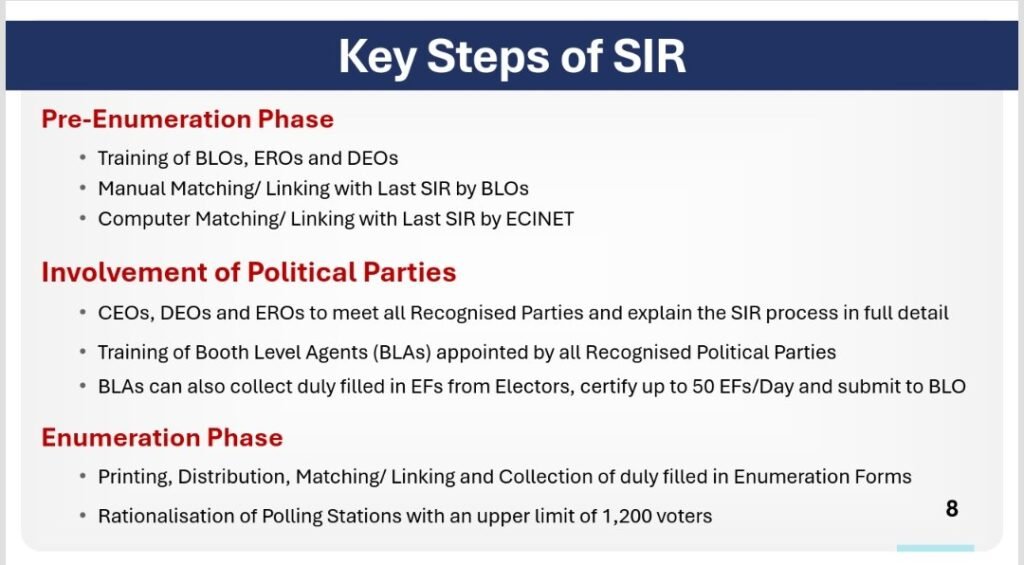
How Does the SIR Process Work?
Understanding the workflow helps clarify why the sir full form in election receives significant attention during election periods.
Step 1: Announcement of Revision
Election authorities officially announce the Special Intensive Revision schedule.
Step 2: Publication of Draft Electoral Roll
A preliminary voter list is released for public inspection.
Step 3: Verification Activities
Field-level officers verify voter information through surveys and record checks.
Step 4: Submission of Claims
Eligible voters missing from the list can apply for inclusion.
Step 5: Filing Objections
Citizens may object to incorrect or duplicate entries.
Step 6: Review and Verification
Election officials examine submitted applications and supporting documents.
Step 7: Final Electoral Roll Publication
After all corrections are processed, the final voter list is published.
Difference Between SIR and Regular Electoral Roll Revision
Many people confuse regular voter list updates with SIR. However, there are notable differences.
| Feature | Regular Revision | Special Intensive Revision (SIR) |
|---|---|---|
| Scope | Limited updates | Comprehensive review |
| Verification Level | Routine | Intensive |
| Data Checking | Basic | Detailed |
| Public Involvement | Moderate | High |
| Electoral Roll Cleaning | Partial | Extensive |
| Frequency | More frequent | Conducted when needed |
This comparison highlights why the sir full form in election is considered an important administrative exercise.
Documents Commonly Used During SIR
During Special Intensive Revision, voters may be required to provide supporting documents.
Common examples include:
- Identity proof
- Address proof
- Birth certificate
- Passport
- Driving license
- Utility bills
- Government-issued identification
- Educational records
- Citizenship-related documents where applicable
Requirements can vary depending on local election regulations.
Benefits of Special Intensive Revision
The sir full form in election carries several benefits for both voters and election authorities.
Accurate Voter Lists
Updated records reduce inaccuracies and administrative confusion.
Better Election Planning
Accurate voter data helps allocate resources effectively.
Reduced Fraud Risks
Duplicate and fake entries become easier to identify and remove.
Increased Public Confidence
Transparent voter verification builds trust in the electoral system.
Improved Democratic Participation
Eligible citizens are more likely to exercise their voting rights.
Role of Election Officials in SIR
Election authorities play a crucial role throughout the process.
Their responsibilities often include:
- Electoral roll management
- Voter registration monitoring
- Data verification
- Field inspections
- Public awareness campaigns
- Document examination
- Claims processing
- Objection handling
- Final roll publication
Their work ensures the success of the Special Intensive Revision exercise.
Challenges Faced During SIR
While the sir full form in election serves an important purpose, implementing it can present challenges.
Large Population Size
Managing millions of voter records requires substantial resources.
Migration Issues
People frequently change residences, making verification difficult.
Documentation Gaps
Some eligible voters may lack required supporting documents.
Data Accuracy Concerns
Inconsistent records can create verification complications.
Public Awareness
Not all citizens understand the importance of participating in revision exercises.
Impact of SIR on Democracy
Democracy thrives when elections are fair, transparent, and inclusive.
The sir full form in election contributes to these goals by:
- Strengthening electoral integrity
- Enhancing voter confidence
- Supporting equal representation
- Reducing administrative errors
- Improving election management
- Encouraging civic participation
An accurate electoral roll is one of the foundations of democratic governance.
Common Terms Related to SIR in Elections
To better understand the topic, it’s useful to know related election terminology.
Electoral Roll
The official list of registered voters.
Voter Registration
The process of enrolling eligible citizens to vote.
Booth Level Officer (BLO)
An official responsible for voter verification at the local level.
Electoral Registration Officer (ERO)
An officer responsible for maintaining electoral rolls.
Draft Roll
A preliminary voter list released for public review.
Final Roll
The updated voter list published after verification and corrections.
Claims and Objections
Formal requests for additions, deletions, or corrections in voter records.
Practical Example of SIR
Imagine a city with 500,000 registered voters.
Over several years:
- Thousands move away
- New residents arrive
- Young citizens become eligible voters
- Some voters pass away
- Addresses change
Without revision, the voter list becomes outdated.
Through Special Intensive Revision:
- New voters are added
- Incorrect entries are corrected
- Duplicate records are removed
- Deceased voters are deleted
- Address updates are recorded
As a result, the electoral roll becomes more reliable and trustworthy.
Why Citizens Should Participate in SIR
The success of the sir full form in election process depends heavily on public cooperation.
Citizens should:
- Verify their voter details regularly
- Respond to verification requests
- Submit corrections promptly
- Encourage family members to check records
- Stay informed about revision schedules
Active participation helps create stronger and more accurate electoral systems.
Future of Electoral Roll Management
Election management is increasingly becoming technology-driven.
Future revisions may involve:
- Digital voter verification
- Online registration systems
- AI-powered data validation
- Integrated government databases
- Mobile voter services
- Real-time electoral roll updates
- Secure digital documentation
However, even with technological advancements, the core purpose behind the sir full form in election remains the same: maintaining accurate voter records.
Conclusion
Understanding the sir full form in election is essential for anyone interested in how democratic elections function. SIR, or Special Intensive Revision, is a comprehensive voter verification and electoral roll update process designed to ensure accuracy, transparency, and fairness in elections.
By identifying errors, removing duplicate records, updating voter information, and including eligible citizens, SIR strengthens the foundation of the electoral process. It helps election authorities maintain reliable voter databases while enhancing public confidence in democratic institutions.