
Have you ever looked at an ice cream cone, a party hat, or a traffic cone and wondered how much space is inside it? That simple question leads us to one of the most useful geometry concepts you’ll ever learn—the cone volume formula.
At first glance, the formula might seem confusing. There are symbols, measurements, and calculations that can make beginners nervous. The good news is that it’s actually much easier than it looks. Once you understand why the formula works and how each part fits together, solving cone volume problems becomes surprisingly simple.
In this guide, we’ll break everything down into easy-to-follow steps. You’ll learn what a cone is, why its volume matters, how the formula is derived, and how to solve different types of problems with confidence. Whether you’re a student preparing for an exam, a teacher looking for simple explanations, or someone who just wants to improve their math skills, this guide will help you master the topic without feeling overwhelmed.
What Is a Cone?
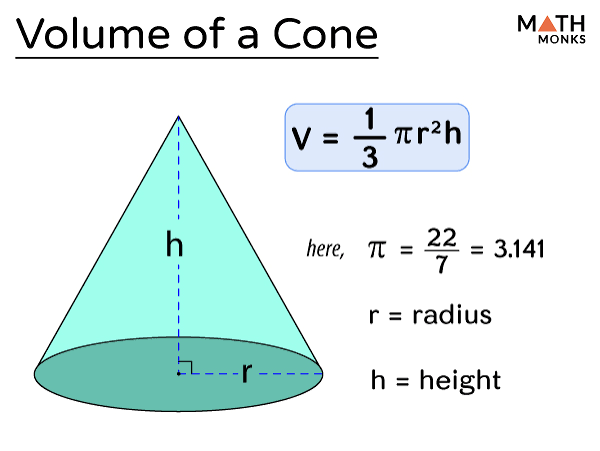
A cone is a three-dimensional geometric shape with:
- One circular base
- One curved surface
- One pointed top called the vertex
- A vertical height connecting the base to the vertex
Unlike a cylinder, which has two circular bases, a cone narrows smoothly until it reaches a single point.
Common real-life examples include:
- Ice cream cones
- Birthday hats
- Funnel-shaped containers
- Traffic cones
- Christmas tree decorations
- Megaphones
- Paper cones
Because cones appear everywhere, understanding their volume has many practical applications.
What Does Volume Mean?
Before learning the cone volume formula, it’s important to understand what volume actually measures.
Volume refers to the amount of three-dimensional space inside an object.
Imagine filling an empty cone with water, sand, or rice. The amount it can hold represents its volume.
Volume is always measured using cubic units, such as:
- Cubic centimeters (cm³)
- Cubic meters (m³)
- Cubic inches (in³)
- Cubic feet (ft³)
Whenever you’re calculating the capacity of a cone-shaped object, you’re finding its volume.
The Cone Volume Formula
The formula used to calculate the volume of a cone is:
Where:
- V = Volume
- π (Pi) ≈ 3.14159
- r = Radius of the circular base
- h = Height of the cone
This is the standard cone volume formula taught in schools and used in engineering, construction, architecture, manufacturing, and mathematics.
Why Is There One-Third in the Formula?
One question almost every beginner asks is:
“Why do we divide by 3?”
The answer is actually fascinating.
Imagine a cylinder and a cone that have:
- The same radius
- The same height
Scientists and mathematicians discovered that it takes exactly three identical cones to completely fill one cylinder.
Since the cylinder’s volume is:
- πr²h
The cone must hold only one-third as much:
- (1/3)πr²h
That’s why the division by 3 always appears in the cone volume formula.
Understanding Every Part of the Formula
Let’s examine each part more closely.
Radius (r)
The radius is the distance from the center of the circular base to its edge.
If you’re given the diameter instead, simply divide it by two.
Example:
Diameter = 12 cm
Radius = 6 cm
Height (h)
Height is the straight vertical distance from the center of the base to the vertex.
Do not confuse this with the slant height.
Pi (π)
Pi represents the relationship between a circle’s circumference and diameter.
For most calculations, you can use:
- 3.14
- 22/7
- Calculator value (π)
Step-by-Step Guide to Using the Cone Volume Formula
Let’s solve a simple example.
Example 1
Radius = 5 cm
Height = 12 cm
Step 1
Write the formula.
V = (1/3)πr²h
Step 2
Square the radius.
5² = 25
Step 3
Multiply.
25 × 12 = 300
Step 4
Multiply by π.
300 × 3.14 = 942
Step 5
Divide by 3.
942 ÷ 3 = 314
Final answer:
Volume = 314 cm³
Notice how straightforward the cone volume formula becomes when you solve it one step at a time.
Example 2
Radius = 8 m
Height = 15 m
Solution:
- Radius squared = 64
- 64 × 15 = 960
- 960 × 3.14 = 3014.4
- 3014.4 ÷ 3 = 1004.8
Answer:
Volume = 1004.8 m³
Example 3
Diameter = 14 cm
Height = 9 cm
First convert the diameter.
Radius = 7 cm
Formula:
V = (1/3)π × 49 × 9
49 × 9 = 441
441 × 3.14 = 1384.74
1384.74 ÷ 3 = 461.58
Answer:
461.58 cm³
Quick Formula Table
| Measurement | Meaning |
|---|---|
| Radius | Distance from center to edge |
| Diameter | Twice the radius |
| Height | Vertical distance |
| Volume | Space inside the cone |
| Unit | Cubic units |
Common Mistakes Beginners Make
Even simple formulas can lead to mistakes.
Here are the most common ones.
Forgetting to Square the Radius
Many students calculate:
π × r × h
instead of:
π × r² × h
Always remember to square the radius first.
Using Diameter Instead of Radius
The formula requires the radius.
If the diameter is given, divide it by 2.
Forgetting to Divide by 3
This is one of the biggest errors.
Without dividing by three, you’re calculating something closer to the cylinder’s volume.
Mixing Units
Keep measurements consistent.
If the radius is in centimeters, the height should also be in centimeters.
Real-Life Uses of the Cone Volume Formula
Learning the cone volume formula isn’t only about passing math exams.
It has many real-world applications.
Construction
Builders calculate concrete quantities for cone-shaped structures.
Manufacturing
Factories determine the material needed for cone-shaped products.
Food Industry
Ice cream companies estimate cone capacity.
Engineering
Engineers design funnels, tanks, and industrial equipment.
Architecture
Architects calculate decorative cone roofs and towers.
Packaging
Manufacturers estimate storage capacities.
Education
Teachers use cone problems to explain geometric solids.
Comparing Cone and Cylinder Volume
Here’s an easy comparison.
| Shape | Formula |
| Cylinder | πr²h |
| Cone | (1/3)πr²h |
Notice that the cone simply has one-third of the cylinder’s volume.
This relationship makes it easier to remember the cone volume formula.
Tips to Remember the Formula
If formulas are difficult to memorize, try these techniques.
- Picture an ice cream cone.
- Remember that cones hold one-third of a matching cylinder.
- Always square the radius before multiplying.
- Keep units consistent.
- Write the formula before solving.
The more practice you get, the easier it becomes.
Practice Questions
Try solving these yourself.
Question 1
Radius = 4 cm
Height = 9 cm
Question 2
Radius = 6 m
Height = 20 m
Question 3
Diameter = 10 inches
Height = 15 inches
Work through each problem using the cone volume formula, then verify your answers with a calculator.
Practice Answers
Answer 1
Volume ≈ 150.72 cm³
Answer 2
Volume ≈ 753.6 m³
Answer 3
Radius = 5 inches
Volume ≈ 392.5 in³
Helpful Memory Trick
Think of the phrase:
“Circle, Square, Height, Divide by Three.”
It reminds you of the order:
- Find the radius.
- Square it.
- Multiply by the height.
- Multiply by π.
- Divide by 3.
Many students find this much easier than memorizing symbols alone.
Only the vertical height is used in the cone volume formula.
Important Terms You Should Know
Understanding these terms will make geometry much easier.
- Cone
- Volume
- Radius
- Diameter
- Height
- Vertex
- Circular base
- Curved surface
- Pi
- Cubic units
- Three-dimensional figure
- Geometric solid
- Base area
- Capacity
- Dimensions
- Measurement
- Geometry
- Mathematical formula
- Solid figure
- Surface
- Space occupied
- Right cone
- Oblique cone
- Vertical height
- Slant height
- Radius squared
- Cross-section
- Solid geometry
- Area
- Circumference
- Circle
- Cylinder comparison
- Mathematical calculation
- Geometry lesson
- Beginner math
- Volume equation
- Formula application
- School mathematics
- Practical geometry
- Engineering math
- Architecture calculations
- Construction measurement
- Capacity calculation
- Exam preparation
- Math tutorial
- Geometry examples
- Step-by-step solution
- Worked examples
- Practice problems
- Math concepts
- Shape measurement
- Three-dimensional objects
- Cone calculations
- Formula explanation
- Spatial reasoning
- Measurement units
- Cubic centimeters
- Cubic meters
- Pi value
- Radius calculation
- Height measurement
- Mathematical reasoning
- Geometry formulas
- Volume calculation
- Everyday geometry
Final Thoughts
The cone volume formula may seem intimidating at first, but once you understand the logic behind it, everything starts to make sense. Instead of memorizing a random equation, think about what the formula represents. A cone is simply one-third of a matching cylinder, and every calculation follows that simple idea.
Practice is the key to mastering geometry. Start with easy examples, double-check your radius and height, and remember to divide by three at the end. Over time, solving cone volume questions will become second nature.