
If you own a vehicle, there is one document that often gets overlooked until a traffic officer asks for it—the PUC certificate. While vehicle owners usually remember their driving license, registration certificate, and insurance papers, many forget about pollution compliance.
In 2026, environmental regulations are becoming stricter across many regions, and maintaining a valid PUC certificate is more important than ever. Whether you drive a car, motorcycle, scooter, taxi, or commercial vehicle, understanding the requirements can save you from fines, legal trouble, and unnecessary stress.
This comprehensive guide covers everything you need to know about the PUC certificate, including eligibility, required documents, testing procedures, validity periods, penalties, benefits, renewal rules, and practical tips for vehicle owners.
What Is a PUC Certificate?
A PUC certificate stands for “Pollution Under Control Certificate.” It is an official document issued after a vehicle passes an emission test conducted at an authorized emission testing center.
The certificate confirms that the vehicle’s exhaust emissions are within the permissible pollution limits established by transportation and environmental authorities.
The primary purpose of a PUC certificate is to:
- Reduce air pollution
- Monitor vehicle emissions
- Improve public health
- Encourage proper vehicle maintenance
- Ensure compliance with environmental laws
In simple terms, it acts as proof that your vehicle is not releasing excessive harmful pollutants into the atmosphere.
Why Is a PUC Certificate Important?
Vehicle emissions contribute significantly to air pollution. Harmful gases released from engines can affect air quality and public health.
A valid PUC certificate helps:
- Reduce carbon emissions
- Lower environmental impact
- Improve fuel efficiency
- Maintain engine performance
- Prevent legal penalties
- Support clean transportation initiatives
Moreover, many authorities consider the PUC certificate a mandatory vehicle document alongside registration and insurance papers.
Understanding Vehicle Emissions
Before discussing requirements, it helps to understand what emission testing measures.
Common pollutants checked during testing include:
| Pollutant | Impact |
|---|---|
| Carbon Monoxide (CO) | Reduces oxygen delivery in the body |
| Hydrocarbons (HC) | Contributes to smog formation |
| Nitrogen Oxides (NOx) | Causes respiratory issues |
| Carbon Dioxide (CO₂) | Contributes to global warming |
| Particulate Matter | Affects lungs and air quality |
Vehicles that exceed permitted emission levels fail the test and must undergo repairs before receiving a PUC certificate.
Who Needs a PUC Certificate?
Most motor vehicles require a valid PUC certificate.
This typically includes:
Private Vehicles
- Hatchbacks
- Sedans
- SUVs
- Motorcycles
- Scooters
- Pickup trucks
Commercial Vehicles
- Taxis
- Buses
- Delivery vans
- Trucks
- Fleet vehicles
Specialized Vehicles
- Construction equipment
- Transport vehicles
- Institutional vehicles
Regardless of vehicle type, owners should verify local emission compliance requirements.
PUC Certificate Requirements in 2026
Obtaining a PUC certificate is generally straightforward. However, vehicle owners must meet specific requirements.
Vehicle Registration
The vehicle must have a valid registration certificate.
Required details include:
- Registration number
- Engine number
- Chassis number
- Vehicle category
Functional Engine Condition
The vehicle should be mechanically sound and capable of undergoing emission testing.
Issues that may lead to failure include:
- Faulty fuel injectors
- Damaged catalytic converter
- Engine misfires
- Excessive smoke emissions
- Poor combustion
Authorized Testing Center Visit
The emission test must be conducted at a licensed pollution testing center.
Unauthorized testing facilities may issue invalid certificates.
Vehicle Identification
Testing personnel will verify:
- Registration number
- Vehicle type
- Fuel category
- Engine specifications
Documents Required for a PUC Certificate
The process is generally simple and requires minimal paperwork.
Essential Documents
- Vehicle Registration Certificate (RC)
- Existing PUC certificate (for renewal)
- Vehicle identification details
- Owner information if requested
In many cases, the registration number alone is sufficient because vehicle data is available digitally.
Types of Vehicles Covered Under PUC Testing
Different vehicle categories have different emission standards.
Petrol Vehicles
Petrol-powered vehicles are tested for:
- Carbon monoxide levels
- Hydrocarbon emissions
- Idle speed emissions
Diesel Vehicles
Diesel vehicles are checked for:
- Smoke density
- Particulate emissions
- Opacity levels
CNG Vehicles
Compressed Natural Gas vehicles undergo specialized emission analysis based on approved standards.
Hybrid Vehicles
Hybrid vehicles may require testing according to specific local regulations.
How Is a PUC Test Conducted?
Many vehicle owners wonder what happens during the actual inspection.
The process usually takes only a few minutes.
Step 1: Vehicle Inspection
The operator verifies vehicle details.
Step 2: Emission Analyzer Connection
Testing equipment is connected to the exhaust pipe.
Step 3: Engine Evaluation
The engine runs under specified conditions while emissions are measured.
Step 4: Data Analysis
Emission levels are compared against permissible limits.
Step 5: Certificate Generation
If the vehicle passes, a PUC certificate is issued immediately.
Information Included on a PUC Certificate
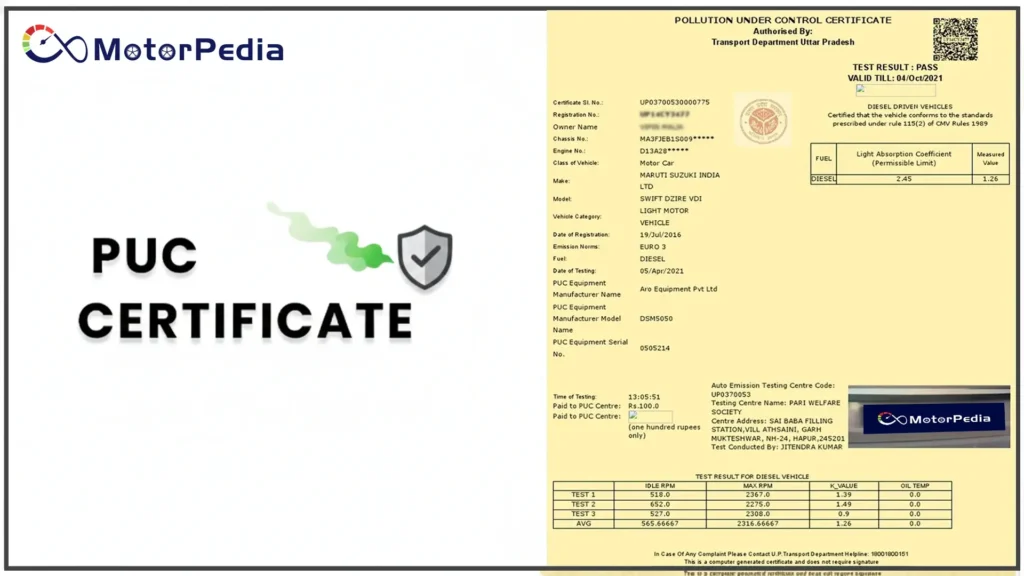
A standard PUC certificate generally contains:
- Certificate number
- Vehicle registration number
- Vehicle type
- Fuel type
- Emission readings
- Testing date
- Expiry date
- Testing center information
Always verify that the details are correct before leaving the testing center.
PUC Certificate Validity Period
Validity varies depending on vehicle age and regulations.
New Vehicles
New vehicles often receive an initial exemption period.
After that, regular testing becomes mandatory.
Older Vehicles
Older vehicles usually require more frequent testing because emissions tend to increase with age.
Typical validity periods range from:
- 3 months
- 6 months
- 12 months
Always check the expiration date printed on your PUC certificate.
How Much Does a PUC Certificate Cost?
Testing fees are generally affordable.
Costs depend on:
- Vehicle category
- Fuel type
- Testing equipment
- Regional regulations
Most emission tests are inexpensive compared to the penalties for non-compliance.
Penalties for Not Having a Valid PUC Certificate
Failing to maintain a valid PUC certificate can lead to significant consequences.
Possible penalties include:
- Traffic fines
- Vehicle inspections
- Legal notices
- Registration-related complications
- Increased scrutiny during roadside checks
Repeated violations may result in stricter enforcement actions.
How to Renew a PUC Certificate
Renewing a PUC certificate is usually identical to obtaining one.
Renewal Process
- Visit an authorized testing center.
- Present vehicle details.
- Complete emission testing.
- Receive updated certificate.
It is advisable to renew before expiration to avoid penalties.
Reasons a Vehicle May Fail the PUC Test
Some vehicles fail emission testing due to maintenance issues.
Common reasons include:
Poor Engine Maintenance
Dirty components can increase emissions.
Faulty Oxygen Sensors
Incorrect air-fuel mixtures can elevate pollution levels.
Damaged Catalytic Converter
A malfunctioning converter often causes test failure.
Dirty Air Filter
Restricted airflow affects combustion efficiency.
Fuel System Problems
Leaking injectors or fuel imbalance can increase harmful emissions.
Tips to Pass a PUC Test Successfully
Preparing your vehicle beforehand improves the chances of passing.
Perform Regular Servicing
Routine maintenance keeps emissions within acceptable limits.
Replace Air Filters
Clean filters improve combustion quality.
Use Quality Fuel
Higher-quality fuel often produces cleaner emissions.
Check Engine Warning Lights
Resolve dashboard warning indicators before testing.
Warm Up the Engine
A properly warmed engine usually provides more accurate readings.
Benefits of Maintaining a Valid PUC Certificate
Many drivers view emission testing as a legal requirement only. However, the benefits extend beyond compliance.
Better Fuel Economy
Efficient engines consume less fuel.
Improved Vehicle Performance
Proper maintenance often results in smoother operation.
Environmental Protection
Reduced emissions contribute to cleaner air.
Legal Compliance
A valid PUC certificate helps avoid penalties.
Increased Vehicle Lifespan
Regular monitoring identifies problems early.
Common Myths About PUC Certificates
Several misconceptions continue to circulate among vehicle owners.
Myth 1: New Vehicles Never Need Testing
New vehicles may have temporary exemptions, but future testing is still required.
Myth 2: Small Vehicles Don’t Pollute
Every combustion engine produces emissions.
Myth 3: PUC Testing Damages the Engine
The testing process is safe and non-invasive.
Myth 4: Passing Once Guarantees Future Compliance
Emission levels can change due to wear and tear.
Digital PUC Certificates in 2026
Digital transformation has made compliance easier.
Many authorities now support:
- Online verification
- Digital certificate storage
- QR code validation
- Mobile access
- Electronic records
Digital systems reduce paperwork and simplify compliance tracking.
How PUC Certificates Support Environmental Sustainability
Air pollution remains a major concern worldwide.
Emission control programs help:
- Reduce greenhouse gases
- Improve urban air quality
- Minimize respiratory illnesses
- Support climate initiatives
- Promote responsible vehicle ownership
The PUC certificate plays a key role in these broader environmental goals.
Frequently Asked Questions
Is a PUC Certificate Mandatory?
Yes, in most jurisdictions, vehicles must maintain a valid pollution compliance certificate.
How Long Does Testing Take?
Most tests take between five and ten minutes.
Can I Renew Before Expiry?
Yes. Early renewal is often recommended.
What Happens If My Vehicle Fails?
Necessary repairs must be completed before retesting.
Do Electric Vehicles Need a PUC Certificate?
Pure electric vehicles generally do not require emission testing because they produce no tailpipe emissions.
Final Thoughts
A PUC certificate is far more than just another vehicle document. It serves as proof that your vehicle meets emission standards, protects the environment, and complies with legal requirements. As environmental regulations continue evolving in 2026, maintaining a valid certificate has become an essential part of responsible vehicle ownership.
Regular servicing, timely testing, and proactive maintenance can make the entire process quick and hassle-free. More importantly, keeping your emissions under control contributes to cleaner air and a healthier future for everyone.